Saturday, January 12, 2008

Photos of people who have lived in three centuries

Photographer Mark Story took photos of people who were born in the 19th century and are still alive in the 21th Century. My own grandmother comes close to making it. She'll be 107 in April.


Picture 9-10
The photographs for this portrait series were taken in various locations around the world between 1987 and 2005.

The Gerontology Research Group estimates there are 250,000 centenarians (people 100 years and older) currently living in the world. In rare instances, people live to 110 years and beyond, inspiring a new demographic label: supercentenarian. The Gerontology Research Group, through rigorous investigation of records, acknowledges about 65 supercentenarians, and estimates that about 350 are alive worldwide today.

The idea to photograph people who have lived in three centuries evolved over the course of the project. First, I was simply interested in taking portraits of people who appear worn beyond their years by living extraordinarily hard lives. Those experiences drew me to centenarians, and on to supercentenarians and their stories.


Link

(Via Ursi's blog)


source

Roy Amara, forecaster, RIP

 Images Roy 1

"We tend to overestimate the effect of a technology in the short run and underestimate the effect in the long run." - Roy Amara (1925-2007)


Roy Amara, engineer, forecaster, and longtime president of Institute for the Future, died on Saturday. At age 82, Roy still made regular visits to IFTF and attended our conferences, always offering sage advice and brilliant bits of insight. Several months ago, I had lunch with Roy and we talked at length about synthetic biology, an emerging field we agreed will likely have a profound impact on our world. At IFTF, we always make a point to look back at history before starting any forecast. As part of his personal interest in the future of synthetic biology and healthcare, Roy told me he was taking a look way back, reading Charles Darwin's diaries from beginning to end.


Roy's career began in 1952 at the Stanford Research Institute where he worked on the development of the ERMA computer. During his 18 years at SRI, he directed research programs on interactive computing, decision analysis, and worked closely with Doug Engelbart on the proposals that led to Engelbart's history-making Augmentation Research Center. In 1970, he left SRI to become president of Institute for the Future, a not-for-profit research group that helps companies, governments, foundations, and other institutions think about the long-term future. At IFTF, Roy established our Ten-Year Forecast, now in its 35th year. In 1977, he led one of the first studies on the possible impact of global climate change.


This year is IFTF's 40th anniversary. We'll miss Roy as we celebrate where his dedication, generosity, and foresight has led us.


source

Video of Bob Staake's unusual drawing process


Bob Staake is a talented and delightful children's book illustrator. I've written about him on Boing Boing before.


Staake once told me that he still draws with a mouse and an ancient copy of Adobe Photoshop 3.0 (on Mac OS 7, I seem to remember). Here's a video to prove it.

This is one guy who won't be switching to a Cintiq anytime soon. It reminds me of Hunter S. Thompson using his IBM Selectric and a fax machine to submit his stories in the 21st century.

No matter -- Staake is an absolute wizard at what he does, and watching his odd drawing process is really something to behold, at least for and Adobe Illustrator die-hard like myself.

Link to Staake's website (Via Drawn!)


source

Adobe Creative Suite fails "catastrophically" thanks to DRM

200801031406

Release 2.0 editor Jimmy Guterman was greeted by this helpful message after he upgraded to the latest version of Adobe Creative suite.

Adobe pushed out an upgrade of its Creative Suite. I installed it, as prompted. This is what happens when I try to run any element of the Suite after the install.

Click on the modal dialog box and the program closes. For extra redundancy, there's a second error message that reads "licensing for this product has stopped working." But I am impressed that I wasn't merely able to get the programs to fail, but that I got them to fail "catastrophically."


Link


source

Surprising origins of a face drawing

In this fascinating three-part story, Steve of "The Sneeze" looks into the history of a face that his father has been drawing for the last 60 years. Steve told Drawn!:


200801031416My father has been drawing this same ‘face’ on my birthday cards and cakes for as long as I remember. I recently started pressing him for info about this face that he’s been drawing for 60 years and it all unfolded with a completely unexpected and satisfying ending.

The interview with his father is funny and heart-warming.

Link


source

Haunted Mansion spiel to be scripted

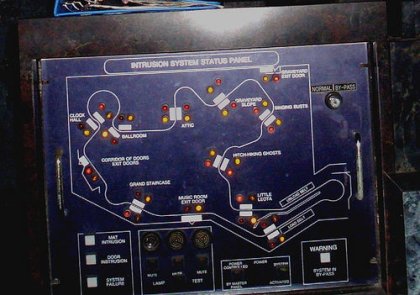
Melanie sez, "Apparently some guests of Walt Disney World's Haunted Mansion have been complaining about the "offensive" ad-libbed lines spoken by the interactive staff in the foyer of the building so someone has decided that the staff will now undergo acting classes and memorize a script of lines to speak to riders."


Truth be told, those macabre remarks that all of those "butlers" and "maids" have made to Disneyland & Walt Disney World guests over the years were never actually scripted. They were just ad-lib lines that got laughs that -- over time -- then became the pro forma dialogue used in the Foyer and the Portrait Gallery.


Well, that's all about to change. According to my sources at WDI, in order to prevent squeamish guests from being offended by semi-improv-ed remarks like "Please follow the blood red carpet into the Foyer," the Imagineers have now written an official script for the Mansion's entrance area. What's more, the cast members who work at both the Anaheim & Orlando versions of this attraction will soon supposedly be asked to attend acting classes. Where they will then be taught the official staging & blocking for this new script.


As you might imagine, once the news of this proposed change started making the rounds among Disney cast members who work at the Mansion, the grousing began. As one Disneyland vet put it:


"Half the fun of working in the entrance area at the Mansion is that you got to play a character of your own devising. You could put a silly or sinister spin on the butler or the maid. It was all up to you. But now with this official script and the new blocking, that's all going to change. It won't be nearly as fun as it used to be to work at the Mansion."


Link

(Thanks, Melanie!)


source

Thursday, January 10, 2008

Flexible steel arm for hands-free calling, 1948

This was how hand-free calling worked, according to the September, 1948 ish of Popular Mechanics:


Holding the telephone ready for use, a “third hand” of flexible steel leaves both the operator’s hands free to take notes during phone conversations. The spring arm holds the receiver to the ear and can be adjusted to the height and position of the user. The third hand was developed in Australia.


Link


source